Description
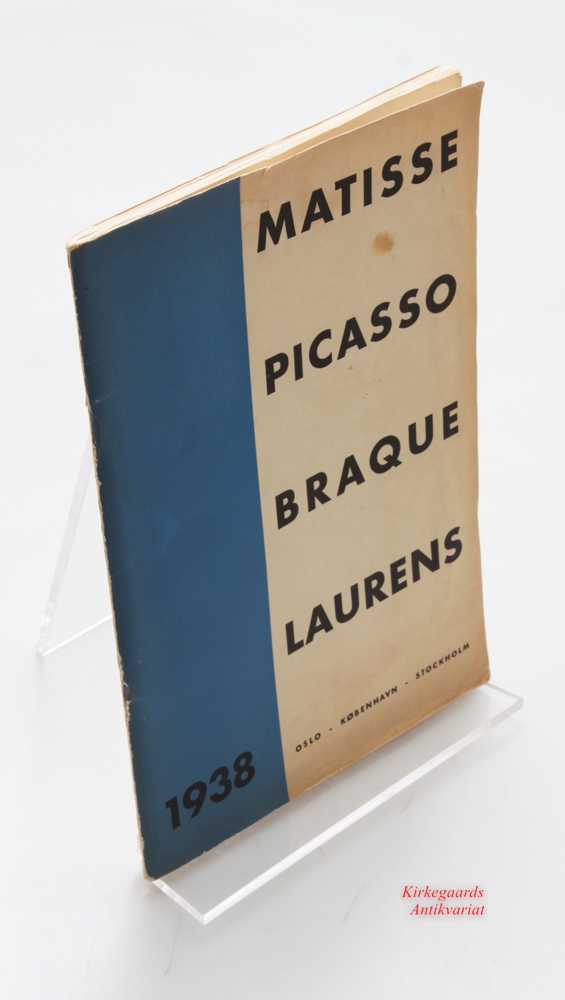
Matisse, Henri. – Picasso, Pablo. – Braque, Georges. – Laurens, Henri. – Larsen, Gunnar (ed.): . Matisse, Picasso, Braque, Laurens. Stockholm – Göteborg – Oslo – København, 1938. Oslo: Kunstnernes hus Oslo – Statens museum for kunst – Liljevalchs konsthall Stockholm Konsthallen, Göteborg, 1938. 8vo in original wraps. 32 pages, complete with tipped in b/w photographic portraits. Texts in Norwegian by Leo Swane, Ragnar Hoppe, Walter Halvorsen & Georges Duthuit. Cover soiled and a contemporary newpaper clipping glued to innercover
First edition, 1st printing of early important catalogue: “From the moment it was unveiled inside the Spanish Pavilion at the Paris International Exhibition of 1937, Guernica ignited the interest of every beholder, either through its standing as Picasso’s latest and biggest work — due to its unusual size compared with the rest of the artist’s work — or its clear political undercurrent and the immediate recognition of its symbolic value. Just months after the exhibition ended, in the spring of 1938, Guernica joined a collective touring exhibition around several Scandinavian cities which assembled the work of four pre-eminent artists from the modern art milieu of Paris: Henri Matisse, Pablo Picasso, Georges Braque and Henri Laurens. As one of Picasso’s most recent works, in 1938 Guernica was part of an exhibition which displayed works by four eminent artists who were integral to the renewal of plastic language — in painting and sculpture — at the beginning of the 20th century, and within the paradigm of modernity (and classicism) in French art. The promoter of the show was Walther Halvorsen (1887–1972), an artist who had lived in Paris since 1909 and worked as a critic and correspondent for a range of art publications. Due to his lengthy spells in the French capital, and through the ties he built with museum institutions and galleries, in both Norway, his country of origin, and Paris, Halvorsen became a key component of the dissemination of French art in Scandinavia, spanning Impressionism, the Fauvists and Cubism. Halvorsen’s ambitious exhibition programme in 1938 was welcomed by the Kunstnernes Hus, in Oslo, the Statens Museum for Kunst, Copenhagen, and Stockhom’s Liljevalchs Konsthall. The first letters to make mention of the exhibition and its touring venues are dated October 1937, with the French press also writing about it and reporting that Guernica, on display in the Spanish Pavilion, was to be part of a circulating show which would take in Scandinavian countries. The correspondence between different organisers and institutions with an interest demonstrates the urgency of the arrangements and the possibilities being discussed to take the exhibition to both Gothenburg and Helsingfors. Matisse, Picasso and Braque all had ties with Paul Rosenberg’s gallery, while Laurens had been at the gallery of his brother, Léonce Rosenberg. The bulk of the works presented by these four artists were dated between 1920 and 1937, and the aim was to employ them to set forth a consideration of temperate classicism, primarily touching on intimate themes to underscore the balance between drawing and colour, forms and volumes. The exhibition constituted soothing art with an amateur, dilettante viewer in mind, as well as collectors and artists, and was representative of a time before the war that was preceded by the ruptures of the avant-garde and the First World War. As portrayed in the exhibition catalogue and the installation photos in different museums, Guernica appeared the most displaced of the ensemble of works on display – its apparent political disruption, inserted in a chronological account of Picasso’s oeuvre, foresaw a rehearsal for the painting’s exhibition possibilities and its museumization, just one year later, in New York’s Museum of Modern Art.” (#57842) DKK160.00