Description
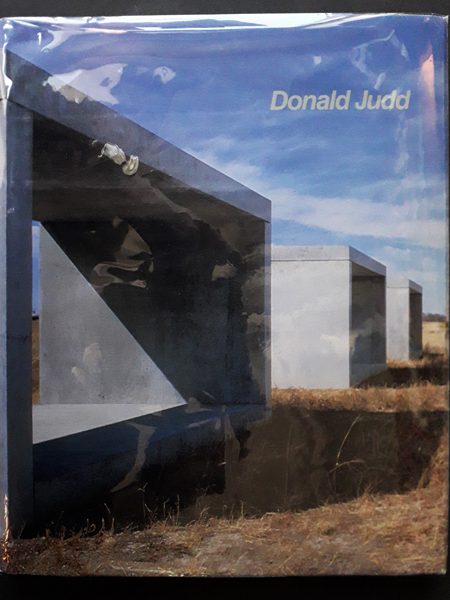
Bronson, AA and Peggy Gale (editors): Museums By Artists
Toronto: Art Metropole, 1983. Small 4to in wraps as issued. 304 pages, richly illustrated. Front corners a bit rubbed else very good copy, clean and tight
First edition, Covers by Daniel Buren, and complete with original pink insert by James Lee Byars
Published in conjunction with show held at Art Gallery of Ontario, Toronto, April 2 – May 15, 1983. Traveled to Musee d’Art Contemporain, Montreal, September 15 – October 30, 1983 ; and Glenbow Museum, Calgary, November 18, 1983 – January 7, 1984
Texts by AA Bronson, Peggy Gale, Jean-Christophe Ammann, Michael Asher, Anne Rorimer, Harald Szeemann, Ursula Wevers, Marcel Broodthaers, Benjamin H.D. Buchloh, Daniel Buren, James Lee Byars, Marcel Duchamp, Robert Filliou, R. Austen Marshall, General Idea, Walter Grasskamp, Daniel Spoerri, Image Bank, Donald Judd, Hans Haacke, Wulf Herzogenrath, On Kawara, Garry Neill Kennedy, Joseph Kosuth, Les Levine, Glenn Lewis, George Maciunas, Piero Manzoni, N.E. Thing Co. LTD., Claes Oldenburg, Coosje van Bruggen, and Garry Schum
“An anthology of texts and works exploring the relationship of the artist to the museum, from Marcel Duchamp’s seminal ‘Boite-en-Valise’ and Claes Oldenburg’s ‘Mouse Museum’ to the critical work of Hans Haacke and Daniel Buren. Harald Szeemann’s proposal for the ‘Museum of Obsessions’ at a future Documenta is here reproduced in English for the first time. With texts / works by Jean-Christophe Ammann, Michael Asher, AA Bronson, Marcel Broodthaers, Benjamin Buchloh, Daniel Buren, Marcel Duchamp, Robert Filliou, Vera Frenkel, General Idea, Walter Grasskamp, Hans Haacke, Wulf Herzogenrath, Image Bank, Donald Judd, On Kawara, Gary Neill Kennedy, Joseph Kosuth, Les Levine, Glenn Lewis, George Maciunas, Piero Manzoni, Claes Oldenburg, Museum of Conceptual Art, N.E. Thing Company Limited, Garry Schum, Harald Szeemann.”
“Museums by Artists was organized by Art Metropole, a business specializing “in materials, related to avant-garde practice” and a member of ANNPAC [Association of National Non-profit Artists Centres]. Art Metropole has also published a book of the same name to accompany the exhibition, the third in a series—Video by Artists and Performance by Artists having preceded it. The ideal of artists’ self-representation as expressed in the title poses a problem here. This self-representation has become instead a principle of accommodation to the museum. Everything about “museums” by artists has been included in this exhibition without an overview or critical principle of organization. That critical principle is what we expect when the most constructive work of the recent past has been critical of the museum. In this exhibition that critique is just one point of view among others. When all these different “museums” are brought together in the museum, does this mean that the museum critique has lost its power, or has it been subverted? Or did this work always accommodate itself to the museum in a dialogue that produced a formal tautology? Or is another strategy operating in Museums by Artists? In whose interest is this accommodation to and so-called “inhabitation” of a museum? Museum by Artists brings together those artworks relating to the museum: works quoting, mimicking or criticizing its classifying and collecting. By the evidence of the works in this exhibition, their forms, formats or framing devices are threefold, although each overlaps the others. They can quote the procedures of the museum or archive as models for its own processes in the miniaturizing or conceptualizing of a collection, with its basis in Duchamp’s Boite-en-Valise, and including Robert Filliou, Glenn Lewis, Les Levine, On Kawara and the N.E. Thing Co. Some can be a global metaphor for one’s own artistic production, with Claes Oldenburg’s Mouse Museum, being a personal collection of objects “classifying” the larger system of his own work, and General Idea’s “The 1984 Miss General Idea Pavillion” with its “destruction” in 1977 and subsequent archaeological retracing serving as exam-ples. Or they may take actual form within the museum, or its stand-in, the gallery, as museological critique: Marcel Broodthaers, Daniel Buren, Hans Haacke, Joseph Kosuth and Garry Neill Kennedy.”