Description
London: Koenig Books 2013. 8vo in softcover. 279 pp. Illustrated. Text in English. Very good copy
1st edition

“Russia, 1917 – A time of complex political upheaval that resulted in the demise of the Russian monarchy and seemingly offered great prospects for a new dawn of art and science. Inspired by revolutionary ideas, artists and enthusiasts developed innumerable musical and audio inventions, instruments and ideas often long ahead of their time-a culture that was to be cut off in its prime as it collided with the totalitarian state of the 1930s. Smirnov’s account of the period offers an engaging introduction to some of the key figures and their work, including Arseny Avraamov’s open-air performance of 1922 featuring the Caspian flotilla, artillery guns, hydroplanes and all the town’s factory sirens; Solomon Nikritin’s Projection Theatre; Alexei Gastev, the polymath who coined the term ‘bio-mechanics’; pioneering film maker Dziga Vertov, director of the Laboratory of Hearing and the Symphony of Noises; and Vladimir Popov, the pioneer of Noise and inventor of Sound Machines. Shedding new light on better-known figures such as Leon Theremin (inventor of the world’s first electronic musical instrument, the Theremin), the publication also investigates the work of a number of pioneers of electronic sound tracks using ‘graphical sound’ techniques, such as Nikolai Voinov, Evgeny Sholpo and Boris Yankovsky. From eavesdropping on pianists to the 23-string electric guitar, microtonal music to the story of the man imprisoned for pentatonic research, Noise Orchestras to Machine Worshippers, Sound sin Z documents an extraordinary and largely forgotten chapter in the history of music and audio technology.”
London: Koenig Books 2013. 8vo in softcover. 279 pp. Illustrated. Text in English. Very good copy
1st edition

 Out of Stock
 Out of Stock
John Cage’s Variations VII. Performed at 9 Evenings: Theatre & Engineering, 69th Regiment Armory, New York City, October 15 and 16, 1966. Sound sources: AM-FM Short Wave Radio, Geiger counter, sine wave generators, horn loudspeakers, contact microphones attached to houshold fans and kitchen appliances, open telephone lines in various locations…

 Out of Stock
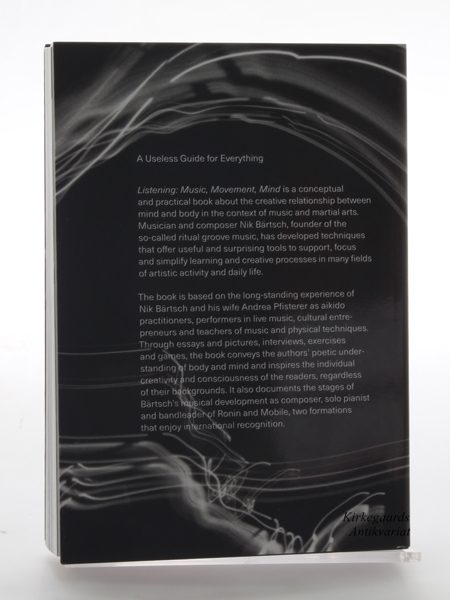
By Nik Bärtsch with Andrea Pfisterer-Bärtsch:. Listening: Music – Movement – Mind. A Useless Guide for Everything
 Out of Stock
