Description
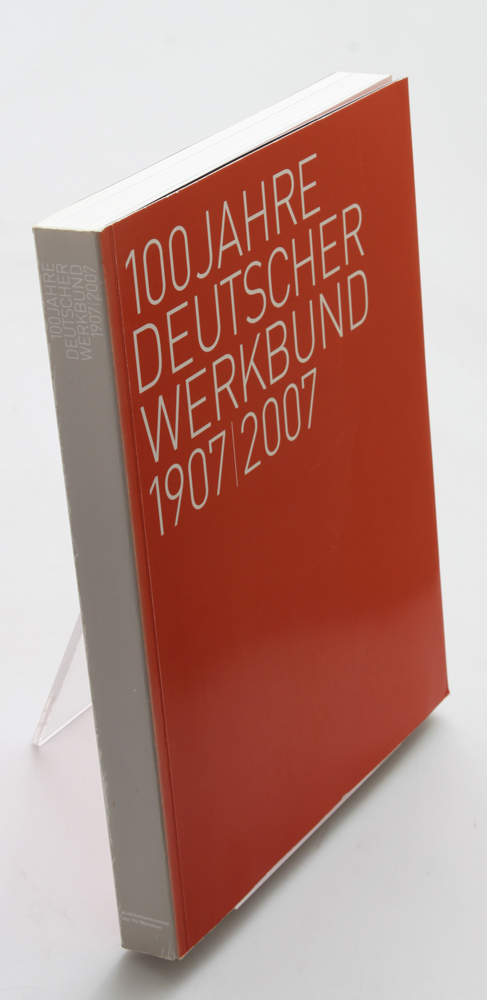
Nerdinger, Winfried & Werner Durth [ed.] . 100 Jahre Deutscher Werkbund : 1907 – 2007. Munich: Architekturmuseum der TU München in der Pinakothek der Moderne, 2007. Large oversized 4to in wraps as issued. 379 pages, richly illustrated in BW and color. Text in German. Spine sunned and light edgewear to cover else overall a clean and very good solid copy. NB: Very heavy item and extra shipping costs will apply, please inquire before ordering this item
1. ed. “The Werkbund Archive – Museum of Things takes the occasion of the 100-year anniversary of the German Werkbund (German Work Federation) to throw a critical eye on the history of the development and reception of this reform movement, and to review the objectives of the Werkbund with regard to their future usefulness in the light of current product culture. The Deutsche Werkbund (German Work Federation) strove towards life reform within the frame of the utopian cultural tendencies of the beginning of the 20th Century. Increasing alienation was to be counteracted with industrially manufactured products, architecture and living space in modern, practical designs. The Werkbund movement intended to create a new context of understanding between designers, producers, salespeople and consumers to establish ethically sound values such as quality, truth and justice to materials, functionality, utility and sustainability. The historic Werkbund-Museum in particular complied with these objectives. The Deutsche Museum für Kunst in Handel und Gewerbe (German Museum of Art in Trade and Industry [DM]) built by Karl Ernst Osthaus from 1909 in Hagen, serves as a structural model for the current Werkbundarchiv – Museum der Dinge. The DM, with its orientation towards contemporary product culture and its diverse mobile “bodies”, was an avant-garde enterprise, with methods which could be carried over to a current museal way of working. The various strategies within the Werkbund were aimed at keeping up the image of a culture which creates unity, using this to oppose the violently erupting social contradictions of the 20th century. The aim of the Werkbund was to give one face to its own time and that the use and exchange value of products should become equal, using the functionalism and practicality derived from technology. Objects should ease people’s lives as silent servants, rather than dominating them as seductive and independent consumer fetishes. Drawing on the image of the Ausstellungszentrale in the context of the Deutsche Museum, the exhibition may be understood as a repertoire of model collections, assembled from the collection of the Werkbundarchiv – Museum der Dinge. They may be expanded into larger exhibitions on each subject. The exhibition is divided into two large areas: The “depot” on the long side of the exhibition space and a central “thematic” axis. For the latter, objects were chosen which, firstly, can convey the basics of the Werkbund work and secondly, can put contemporary product culture up for consideration against this thematic background. In the cupboards on the long side, more collections about object culture of the 20th century are presented in a storage mode. Through this comparison the excerpts from the collection chosen for the exhibition should be understandable to visitors and the various ways of reading the stock should be highlighted. The concentration on product culture, defined by goods and mass production is based on the direction of the museum’s collecting practice. Architecture, graphics and photography as central areas in the spectrum of activities of the Werkbund are only peripherally considered, in a more documentary form. Why battle of objects? It was not the primary objective of the German Werkbund to fight, yet it developed sophisticated battle imagery, aimed at “bad” products from craft mass production and commodity fetishism. The necessity of an aesthetic and morally based “recovery” of German arts and crafts was established, not least with commercial interests. Good form was propagated up to the 60s in publications and exhibitions, with the help of Warenbücher (product catalogues) and Werkbundkisten (Werkbund boxes) (…)”.